

Water Service Policies
Rules and standards for connecting and maintaining BPU water service.
Home > About BPU > Policies > Water Service Policies
Browse the Policy
Click any section to read the details.
Water Policies Definitions
The following terms shall have the following meaning when used in the Water Policies, unless otherwise stated:
- After-Hours Shut-off Service for Contractors:
Fee charged to Contractors for after-hours services provided by KCBPU to temporarily shut off 1- 1/2” and larger services due to construction activities. KCBPU will provide this service as a courtesy during normal working hours. - After-Hours Delinquent Turn-On for Large Customers:
Fee charged to customers for after-hours services provided by KCBPU to turn on 1-1/2” and larger service for delinquent payment. - Battery Meter Setting:
The parallel installation of two or three meters on one service. Battery Meter Settings are no longer installed under current standards. - Corporation Stop:
The valve located at the main at the point of connection for water supply service up to and including one inch in diameter. - Curb Stop:
A valve located on water service pipes of three-quarter inch to one inch, inclusive, at or near the curb line. - Curb Stop Box:
A box or housing which encloses, protects and provides access to the curb stop. - Demolition/Disconnection (Saw-Off) Inspection Fee:
Service fee charged to plumbers or customers as required for KCBPU to inspect the physical disconnection (Saw-off) of a service. - Development Review Committee (DRC) Service Fee:
The Unified Government of Wyandotte County/Kansas City, Kansas (UG) has a Development Review Committee (DRC) to review all major development projects. This fee will be incorporated into the UG’s fee structure to recover KCBPU personnel costs of providing this review. The UG will then reimburse collected fees to KCBPU. - Engineering Design Services Fee:
Fee charged to Developers for KCBPU Engineering design of proposed residential, commercial or industrial development. - Fire Hydrant Flow Test Service Fee:
Fee charged to Insurance Companies or others as requested for fire hydrant flow testing. - Fire Line Usage Fee:
Fee charged to customer for registered water consumption through a fire line for purposes not related to fire suppression. - Leak Investigation Fee:
KCBPU will continue to provide courtesy service for assisting homeowners and businesses investigate leaks on their property. Fees may be charged to customers requesting additional inspections. KCBPU does not guarantee finding the exact location of the leak and fees may apply for additional inspections. - Main and Water Main:
Any system of water pipes, fittings and appurtenances owned by KCBPU and used to distribute water within the area served by KCBPU. - Meter Box Valve:
A valve located on water service pipes of three-quarter inch to one inch, inclusive, in the meter box at the inlet of the water meter. - Meter Fee:
Fee charged to customer for the meter, meter delivery, and installation inspection. - Point of Delivery:
The point at the water main where the control valve is installed. - Private Main:
Any system of water pipes, fittings and appurtenances used to distribute water within the area served by KCBPU in a city right-of-way or dedicated utility easement but owned privately by a customer or customers. The private main shall have a control valve and valve box at or near KCBPU’s supply main and each customer on the private main shall have individual service control valves at or near the private main connection and individual meters. - Roadway Valve:
An approved valve located on water service pipes, of one and one-quarter inch and larger, at or near the main. - Roadway Valve Box:
A box or housing which encloses, protects and provides access to the roadway valve. - Rules and Regulations Manual Pertaining to Water Service:
As adopted by the General Manager, shall mean the Water Engineering Department Rules and Regulations Manual providing supplemental and specific information regarding Water Operations and procedures, material specifications and other pertinent information to be utilized in conjunction with KCBPU Policies Applying to Water Service. - Service Area:
All areas in which KCBPU is authorized by the Kansas State Legislature to supply water service. - Service Connection:
Tapping or installing a tee in a main for a water supply service. - Service Control Valve:
The valve located on water service pipes (meter box, curb stop, or roadway valve) and delineates the responsibility between KCBPU and the Customer. - System Development Fee:
Fee charged for all new service connections to compensate KCBPU for the investment impact on KCBPU’s water supply, treatment, transmission, and storage facilities. - Tap Fee:
Fee charged to customer for KCBPU installed service connection, including tap and valve. - Water Service:
The pipe fittings and appurtenances extending from the water main to the stop and drain valve on the customer’s premises. - Water Service Stub:
The water service from the main to the first control valve.
Overview
Purpose:
To provide a detailed guide for conduct of actions and indicating the responsibility and requirements of both the Kansas City Board of Public Utilities, (KCBPU) and the Customer with regard to the application for water utility system service, billing and collections, delivery and use of water system services, user fees, charges for services, and general service policies.
Intent: To provide for all Customers of KCBPU efficient, safe and reliable service and uniform, consistent and equitable consideration.
Scope:
These policies apply to Water Services furnished by KCBPU to the utility’s Customers. Please be advised that other Federal, State, and Local laws or rules or regulations may apply.
Conflicts
Conflicts:
In case of conflict between any provisions of an Adopted Fee Schedules or special contract and these Policies, the provisions of the Adopted Fee Schedules or special contract shall apply.
Severability:
These policies are severable and if any of the policies are considered invalid, it shall not in any way affect the validity of any of the other several policies.
Service Agreements
Customer Present for Connection:
Water Service will not be connected unless the Customer, or their responsible agent, is on the Premises to inspect the plumbing for leaks and/or open faucets.
In unusual circumstances, as determined by KCBPU, this rule may be waived, but only after the Customer has signed a written release of liability before the Water Service is connected.
The Customer will be required to pay a connection fee as determined by KCBPU.
Leave-On Status:
Landlords can request their properties be placed on a leave-on status for a reduced connection fee as determined by KCBPU.
Meter Reading Necessary:
A meter reading must be made by KCBPU at any time a connection or disconnection service is performed.
In the case of a Customer disconnection and a new Customer connection, on approximately the same date at the same meter, a single reading obtained by KCBPU may be sufficient. In the event there is no access to the meter, the service may be discontinued until the new Customer makes arrangements for a meter reading.
Reselling or Redistributing of Utility Services:
Refer to the Resale of Services policy.
Rates and Payment of Bills
Water Rates:
Effective rate schedule information is available at KCBPU.
Meter Accounts:
The applicable Inside City or Outside City volume charge rate will be applied to each service line and associated meter installation. Battery installations in which two (2) or more meters are installed in a parallel position on the same service line will be combined for the volume charge.
Adjustments for Water Leakage:
If a residential class Customer incurs a loss of water due to a break or failure in their plumbing between the first controlling valve and the exterior wall of the foundation and the water loss has been registered on the meter, an adjustment of the Customer’s bill may be made in accordance with the following provisions:
- Burden of Proof: The Customer must make a request for adjustment to KCBPU and prove the high bill was due to a water leak between the first controlling valve and the exterior wall of the foundation. All service repair work will require the proper maintenance permit and inspection, per KCBPU policies, in order to qualify for an adjustment.
- Amount of Loss: The water loss must be more than their previous twelve month average.
- Length of Adjustment Period: An adjustment of one billing cycle may be made once the Customer has been notified by the KCBPU of the existence of a water leak between the first controlling valve and the exterior wall of the foundation. An adjustment of two billing cycles may be made in the event that a Customer is not notified by the KCBPU of the existence of a water leak between the first controlling valve and the exterior wall of the foundation.
- Limitations on Adjustments: Adjustments will not be made for repeat occurrences where water loss is due to faulty plumbing repairs or neglect of the plumbing system. All repairs must be made in accordance with current KCBPU specifications and approved materials. One adjustment may be granted every thirty-six months.
Fire Line Usage Fee:
The Customer will be required to install an approved metering assembly, at the discretion of KCBPU, when it is determined that any registered water consumption through their fire line service is due to an activity not related to the intended purpose of fire suppression. The cost to purchase and install a metering assembly and associated fees will be at the Customer’s expense.
The Customer shall be assessed a Fire Line Usage Fee, as determined by the KCBPU, upon two (2) consecutive months of registered water consumption of four (4) ccfs or more through their fire line service. Fee will be retroactive and applied to the first month of detected water usage. Fee will continue to be applied until consumption ends or falls below four (4) ccfs per month.
The Customer will be assessed a Fire Line Usage Fee, as determined by the KCBPU, when it is determined that any registered water consumption through their fire line service is due to an activity not related to the intended purpose of fire suppression.
Construction water and special services
Metered Service:
Water used for construction related work shall be metered. The Customer shall pay for the installation and removal of a temporary fire hydrant connection and meter, a daily rental fee with a minimum of five (5) days plus consumption. The Contractor is required to install a backflow prevention device on the outlet side of the meter or air gap for tankers that meet the Engineering Department Rules and Regulations Manual Pertaining to Water Service.
If the KCBPU determines that a Main connection is more desirable than a fire hydrant connection, the Customer shall pay the cost of a new metered service and Main connection. The Customer shall also pay the cost to disconnect the service at the Main when the service is no longer needed.
After-Hours Shut-Off Service for Contractors:
Contractors may request the KCBPU to shut off 1-1/2 inch and larger Water Services on a temporary basis during Normal Working Hours. For shut-offs requested after hours and on weekends, the contractor will be required to pay an after-hours contractor service fee as determined by the KCBPU.
Engineering Design Service:
KCBPU will provide engineering design service for Main extensions. These designs are primarily for residential development but may also include commercial and industrial development. The developer requesting the service is required to pay an Engineering Design Services Fee as determined by the KCBPU.
Development Review Committee (DRC) Services:
The KCBPU Engineering Staff shall participate in the review of major development projects in conjunction with the Unified Government of Wyandotte County (UG) Development Review Committee (DRC). The UG currently has a fee structure in place to recover KCBPU Personnel costs to provide this review.
Fire Hydrant Flow Test Services:
KCBPU will provide fire hydrant flow tests for insurance companies of its large commercial and industrial Customers and other Customers as requested. The insurance companies or the Customer is required to pay a flow test service fee as set out in the Adopted Fee Schedules.
After-Hour Turn On/Offs Service for Customers:
Customers may request the KCBPU to turn on/off 1-1/2” and larger service after hours for delinquent payment. For turn on/offs requested after hours and on weekends, the Customer will be required to pay an after-hours service fee as set out in the Adopted Fee Schedules.
Water services and water service connections
Application for Service:
Every Person desiring to connect their property with a Main, or desiring to replace or relocate any supply connection, supply pipe, or service pipe thereto connected with a Main shall make application to KCBPU Engineering Department for a permit for doing said work. Each application for such permit shall be made in writing on forms to be furnished by KCBPU and shall state the size pipe to be used, the legal description and the street address of the property to be supplied with water, the nature of water usage, the full name of the owner of such property, and the name of the registered master plumber or fire suppression system contractor who is to do said work. The application for service shall be signed by both the owner of the property to be served or his/her authorized representative and the registered plumber who will perform the work.
Upon conformance with KCBPU policies, specifications and standards, payment of the New Service Connection charge and System Development Fee (SDF), and any fees associated with the Service Connection, KCBPU will issue a Permit.
Permits:
Permits are classified and defined as follows:
- Permit for New Service: Water Service permits are required when Service Connections and new services are to be installed.
- Permit for Maintenance of Service: Water Service maintenance permits are required by KCBPU when an existing service is to be altered, extended, repaired, or renewed and when a service is disconnected at the Main. All work to existing services shall meet current KCBPU installation standards. This includes installing a new meter box or upgrading meter box to current standards if the meter is inside the dwelling and installing pipe to current material standards.
- Disconnection or Abandonment of Existing Service: Plumbers shall be responsible for sawing off the outlet threads of the Corporation Stops of old services on the property to be served before a tap and final inspection of the new service will be made.
- Reconstruction of Dwelling: Reconstruction of a structure where an existing Water Service is present shall require the supply pipe to be replaced if it is of a material such as galvanized steel, pitted copper, or other material deemed to be unacceptable by KCBPU, or has been previously repaired, or is considered to be in poor condition. Existing Service Abandonment by KCBPU: Where an existing structure was demolished or the dwelling is uninhabitable, the KCBPU may abandon and disconnect the service if there has been no water use for a period of 2 years. The property owner will be responsible for future replacement of said service.
- Permit Responsibility: Water Service permits are not transferable. Licensed plumbers that procure permits for any unauthorized Person or Persons may be refused subsequent permits.
- Registered Plumber to Complete Work: Only plumbers licensed and bonded with the Unified Government may obtain permits from KCBPU to perform any work in establishing a new water supply or to alter an existing water supply.
- Excavation Permit Required: If any proposed work is in the UG’s Right of Way, an excavation permit must be obtained from the Unified Government before the KCBPU will issue the appropriate permit.
- Plan Approval: Plumbers, Developer and Engineer must submit required Engineering plans and plat plans of apartment Buildings, apartment complexes and commercial Buildings. Plans for a single family dwelling shall require submission of a plot plan. Plans must be submitted to the Engineering Department for review and approval by KCBPU prior to obtaining a permit for construction. Commercial and Industrial Projects require plan submittal review and approval through the Unified Government Development Review Committee. Projects outside of the Unified Government jurisdiction are subject to the same plan review requirements.
- Permit Fee: The plumber shall pay to the KCBPU, the cost of all Service Connection fees required for the new service as outlined in PW-410-002. The payment shall be made prior to the permit being issued.
- Permit Completion: Completed permit(s) must be returned to the KCBPU field representative at the time of final inspection. The permit shall be complete with all data, including material information, measurements and sketch of work prior to receiving final approval at the time of inspection.
- Permit Denial Due to Delinquent Payments or Policy Violation: The KCBPU will refuse to accept an application for a Service Connection or issue a permit for service repairs or alterations if the applicant is delinquent in payment for past Water Services, Main Extension Agreements, or violates the KCBPU’s policies applying to Water Service.
- Permit Expiration and Cancellation: If the connection to the Distribution Main is not completed within 120 days from the issuance of the Permit, the Permit shall expire. The applicant may re-apply and receive credit for previously paid permit fees for this location. The applicant may cancel the Permit at any time and shall be refunded the fees and costs for new service.
Service Connections:
- Service Connections Regulations: All Service Connections shall be under the jurisdiction of KCBPU and in compliance with the KCBPU Policies Manual.
- Type of Service Connection: Service Connections approved by KCBPU include Domestic Service Connection, Irrigation Connection, Fire Line Connection, Temporary Service Connection, Combination Fire and Domestic Service Connection.
- The Service Connection, which includes the Corporation Stop or the first control valve, (for larger services), shall be installed by KCBPU at the expense of the Customer. The Customer/plumber will be required to pay a Tap Fee as determined by KCBPU.
- Service Installation Responsibility: The Water Service shall be installed by the Customer at their own expense from the Corporation Stop or the first control valve to a stop and waste valve within the basement or Building wall.
- New Water Service System Development Fee: For all new Service Connections, the Customer shall pay a water System Development Fee as determined by KCBPU based on meter size. This fee is designed to compensate the Water Service provider for the applicable costs of investment required for the additional development of water supply, treatment, transmission, and storage facilities due to increased water demand within the service territory.
- Existing Service System Development Fee: A System Development Fee also applies to existing Customers wishing to increase the size of their existing water meter and service. The amount of the fee for the change in meter size shall be the difference between the larger Meter Fee and existing Meter Fee at the time of application for the new meter.
- Service Connection for Domestic/Irrigation: Each residential, commercial and industrial Building on a single lot shall be served through one (1) Service Connection. At the discretion of the Water Operations Manager, an exception may be made for multi-Building apartments and mobile home parks that are platted on a single tract of land and the Water Main is installed in a public street right of way and the Water Main internal to the Development is designated as a public Water Main. An exception may also be made by the Manager of Water Operations for special institutions such as hospitals or similar multi-Building complexes requiring redundant water supply service.
- Service Connection for Fire Service: Each commercial and industrial Building requiring a fire service line shall be served through a single Service Connection.
- Service Connection for Combination Domestic and Fire Service: A combination service for fire line and domestic service may be approved by KCBPU for a single plat development with multiple Buildings such as an apartment complex. The Development does not have public street right of way inside the Development and the interior of the complex requires fire protection and domestic service for each Building. All Mains, services and appurtenances in this type of development are owned and maintained by the property owner. A single Master Meter type shall be a UL approved Fire Meter Compound Type (FMCT) specified by KCBPU and provided by the Customer. System Development charges for this meter will be based upon the domestic demand requirements. To that end, the project Mechanical Engineer shall submit the Building code calculations for peak demand based upon the unit fixture count. KCBPU will review and select the meter size required to meet or exceed the calculated demand.
- Excavation Required by Plumber: It shall be the responsibility of the plumber to provide an excavation of adequate size to allow the connection work to be performed satisfactorily. A detailed drawing is available at KCBPU’s Plumbing Desk, which shows the size of the required excavation based upon the size of the tap.
- Restoration of the Right of Way: Excavation and backfilling in the Right-of-Way shall be done in accordance with the Technical Provisions and Standard Drawings of the Unified Government. In addition, projects involving Horizontal Directional Drilling will follow the construction and containment requirements in Appendix B of the UG Technical Provisions and Standard Drawings.
- Inspection of Water Services: New Water Services, extension of services, maintenance of Private Mains, disconnected services, and all repairs of services, shall be inspected by KCBPU before being covered. When the services of a tapper are required, the Water Main shall be exposed and made ready for the arrival of the tapper. The installation of the service in the trench shall not be required at the time of the tap; however, an inspection can be made by the tapper if he is not delayed in their work. When an inspection is requested in the morning, notice shall be filed with the KCBPU plumbing desk not later than 4:00 pm the previous workday, and if requested in the afternoon, the request should be made before 10:00 am. All work up to and including the stop and waste valve shall be completed and a licensed plumber shall be on the job at the time of the inspection. If the work has been performed in accordance with KCBPU’s specifications, the inspector shall furnish the plumber with a written report of approval. An additional fee may be charged if a second trip is required for a tap or inspection. Plumbers shall not turn the water on except for testing purposes. If a service is covered or backfilled before an inspection can be made, the service will not be “turned on” until it has been exposed for proper inspection. The meter can be installed at the time of inspection.
- Protection of Existing Water Mains and Services: Plumbers are responsible for the protection of Water Mains and services during the time of installation or repair of services against breakage, freezing and other types of damages caused by said plumber. Any damage to the polyethylene encasement or tracer wire covering the Main during trench excavation shall be properly repaired by the plumber. Water Service will not be provided until the repair has been inspected and approved. An additional fee may be charged if a second trip is required for inspection.
Choice of Water Mains for Services:
If there is more than one Water Main adjacent to the Premises to be supplied, the KCBPU shall determine which Main shall be used.
Ownership and Maintenance:
The owner of each premise shall retain ownership and shall maintain all supply connections, supply pipes, stop boxes, Curb Stops, valve boxes, service pipes, meter vaults, meter Structures, and backflow prevention assemblies for such Premises in good repair and operable condition at their own expense unless noted otherwise herein. Permits issued on or after August 22, 2019, KCBPU will assume maintenance responsibilities or replacement of the Water Service from the Main connection to the Customer’s first control valve after a period of two (2) years from the time of the final inspection for ¾” -1” services. Permits issued prior to August 22, 2019, KCBPU will assume maintenance responsibilities or replacement of the Water Service from the Main connection to the Customer’s first control valve after a period of one (1) year from the time of the final inspection for ¾” -1” services. All other service sizes are the responsibility of the Customer immediately on installation.
- Replacement/Repair of Existing Service during KCBPU construction: KCBPU is not responsible for the Customer side of the service when performing service transfer for construction of a new Water Main or when completing maintenance of the service as noted above. If the Customer side of the service cannot withstand routine maintenance and work associated with service transfers, the Customer shall repair or replace the service between the meter box and the dwelling. KCBPU reserves the right to temporarily shut off service if repair or replacement is not completed as directed by KCBPU.
- Repair or Replacement of Service Due to Leak on Customer Side: When a supply pipe needing repair is determined to be of a material such as galvanized steel, pitted copper or other material that does not meet KCBPU’s current specifications, the supply pipe shall be replaced. Replacement of an existing service requires the owner to upgrade the service to current KCBPU standards. This includes installing a new meter box or upgrading meter box to current standards if the meter is inside the dwelling and installing pipe to current material standards. When a water supply pipe or Water Service pipe is of acceptable material and condition, it may be repaired.
Leak Investigation:
KCBPU assists Customers with the investigation of water leaks on their side of the Water Service line. If the water leak is on the Customer’s side of the service, the property owner is responsible for repairs. If the Customer does not repair and subsequently notifies KCBPU to investigate a second time, the Customer will be required to pay a Leak Investigation Fee as determined by KCBPU. KCBPU does not guarantee locating a water leak upon investigation. The Customer will be required to obtain the services of a private company to locate the leak if KCBPU cannot determine the location.
Installation of Service:
Installation of Service shall be completed in accordance with KCBPU Policies, specifications, drawings, letter of requirements and Policy Manual. General installation requirements for Water Services are provided below.
- When installing or replacing Water Services, all installation standards and materials used in the service shall be in accordance with KCBPU specifications, which can be found in KCBPU’s “Rules and Regulations Manual Pertaining to Water Service”.
- The meter pit must be located in the public right-of-way or easement within one (1) foot of the applicant’s property line.
- Water Services shall be in a trench separate from gas or sewer trenches.
- All services are to have a minimum of three feet six inches (3’6”) of cover.
- All excavating and back filling for services shall be the responsibility of the plumber on original installations.
- Services supplying duplexes shall be individual connections at the Main with separate ¾” services with individual meters in a separate meter box.
- All tees, bends, tapping sleeves and other fittings must have a concrete thrust blocks or restraint approved by KCBPU.
- Service Connections to polyethylene encased Water Mains will require the service to be encased in polyethylene for the first three (3) feet on the outlet side of the corporation, tapping valve or gate valve.
- All ductile iron services and fire lines shall be encased in polyethylene for the entire length of the pipe.
- Service lines shall be laid at least ten feet horizontally from any existing or proposed drain or sewer line or in accordance with the Uniform Plumbing Code as adopted and modified by the Unified Government.
Installation / Replacement of “Stop and Waste” Valve:
- An Operable Stop and Waste Valve shall be installed on three- quarter inch (3/4”) and one inch (1”) services immediately within the basement or Building wall.
- Services larger than one inch (1”) shall have an operable gate valve or an operable ball valve installed immediately within the Building wall. All valves shall be in accordance with the KCBPU’s specifications and kept in repair by the Customer to enable the Customer to shut off the water for repairs.
Discontinuance of Water Service:
It shall be the Customer or property owner’s responsibility to obtain the services of a plumber to physically disconnect the Water Service at the Service Connection when the structure being supplied has been razed or demolished.
- The plumber shall saw off the outlet threads of Corporation Stops three-quarter inch (3/4”) through one inch (1”) in size. All disconnected Water Services shall be inspected by KCBPU, prior to being backfilled. The Customer/plumber will be required to pay a Demolition/Disconnection (Saw-Off) Inspection Fee as determined by KCBPU.
- For Service Connections one and half inches and larger (1-1/2”), the plumber will be required to pay KCBPU a fee to disconnect the service based on the cost of material, labor and overhead. The plumber shall provide an excavation of adequate size to allow the work to disconnect the Water Service by KCBPU to be performed satisfactorily. The plumber shall also remove meter pit and all piping as part of the disconnection of service. Backfilling of the excavation and right-of-way restoration shall be the plumber’s responsibility.
- Existing Service Use after House Demolition: If a homeowner is razing the residence and desires to utilize the existing service in the future instead of sawing off the service at the Water Main, the homeowner is required to install a sanitary yard hydrant, a double check backflow preventer, and maintain the service with a meter until new construction of the residence is compete. The existing service must meet current KCBPU Installation standards.
Measurements:
Location and size of corporations Curb Stops, meter box and any other measurement records kept and furnished by KCBPU are not guaranteed.
Meters – installation, maintenance and testing
Specifications:
The size, type, configuration and location of the water meter to be used on each service will be subject to approval of KCBPU.
Meter Fee:
The Customer is required to pay a Meter Fee, as determined by KCBPU for the meter, meter delivery and inspection.
For new services and for existing services that require increased meter size, the Customer must pay a System Development Fee as determined by KCBPU. The fee is based upon meter size. For existing services, the fee will be determined by the difference between the fees for the new meter size less the existing meter size. Credits will not be given for meter size reduction.
6” and larger meters and FMCT meters shall be furnished by the Customer in accordance with KCBPU specifications.
Location of Meter:
Meters shall be installed in a meter pit, equipped with an approved electronic radio transmitter. Meters may only be located in an alternate location with the approval of KCBPU.
If KCBPU has been unable to gain access to an inside meter after three (3) unsuccessful attempts, KCBPU may shut off the Water Service.
Meters must be kept accessible at all times. If the meter is not accessible, is subject to freezing, creates a safety hazard, or causes damage to the Customer’s property, KCBPU will require that the meter be moved to a more suitable location, at the Customer’s expense.
Meter Housing Construction:
All meter pit and valve material selections shall be approved by KCBPU.
Repairs Residential: KCBPU shall, at its expense, replace defective meters installed on residential services.
Residential meters found not to be in accurate working condition shall be repaired or replaced by KCBPU at no cost to the Customer. Meters found to be damaged due to Customer abuse or negligence will be repaired or replaced at the expense of the Customer.
Sealing:
KCBPU shall seal all meters in service with an approved sealing device, bearing an identifying KCBPU mark. Plumbers shall notify KCBPU whenever it is necessary to break the seal.
Authorized Handling:
Only authorized KCBPU employees, or the Person authorized by the KCBPU shall set, change, move, interfere with, or bypass any water meter. Any unauthorized attempt by a Customer or company to divert or bypass a water meter shall be considered theft of water and will be reported to KCBPU’s Revenue Protection Department to be investigated for possible diversion service and prosecution in civil court.
Customer Request Test:
KCBPU will make an accuracy test when requested by the Customer. If the test proves accurate the Customer will be billed the expenses for the in accordance with KCBPU’s Adopted Fee Schedules for water meter testing and inspection.
Damage Responsibility:
KCBPU shall not be responsible for damages caused by meter leaks in puts or Buildings. Damaged meters, meter boxes or pits, or those that need to be relocated or adjusted due to change of grade shall be the Customer’s responsibility.
Repairs Commercial & Industrial 1.5”-4”:
KCBPU shall, at its expense and determination, replace defective meters, 1.5” through”, installed on Commercial and Industrial Water Services.
Commercial and Industrial meters, 1.5” through 4”, found not to be in accurate working condition, as determined by KCBPU, shall be repaired or replaced by KCBPU at no cost to the Customer. Meters found to be damaged due to Customer abuse or negligence will be repaired or replaced at the expense of the Customer.
Repairs Commercial & Industrial 6” and Larger:
KCBPU shall, at its expense and determination, provide meters to replace defective meters, 6” and larger, installed on Commercial and Industrial Water Services. The Customer shall, at their expense, install the replacement meter.
Meter Housing Repairs Commercial & Industrial:
The Customer shall be responsible for the maintenance of the meter pit, piping, and valves located past the first controlling valve on commercial and industrial service 1.5” and larger.
Discontinuance of service by KCBPU
Discontinuance of Service:
For failure to comply with KCBPU’s request for entry after notice. If KCBPU has been unable to gain access to an inside meter after three (3) unsuccessful attempts, KCBPU may shut off the Water Service.
Method:
Discontinuance of Water Service may be by turning off the Curb Stop, removing an outside meter or by turning off or sawing off the Main connection.
Discontinuance of service by customer
Notice:
A minimum of twenty-four (24) hours’ notice shall be given to KCBPU when the Customer desires the service to be discontinued because of a change of landlord or responsible Customer or agent.
Temporary Discontinuance:
If a Customer requests a temporary discontinuance of Water Service for any reason, KCBPU will make the “turn off.” If the Customer’s service line does not have a stop and waste control valve KCBPU shall notify the Customer they must install a valve on his Water Service line at an acceptable location inside their Building before the water will be turned back on. If the service discontinuance request is made at such a time the Customer cannot purchase a valve, the Customer will be given three (3) days to obtain a valve and notify KCBPU. If, after three (3) days, KCBPU has not been notified, the service may be discontinued and a charge assessed to the Customer. The stop and waste control valve is for the use of the Customer and it is the responsibility of the landlord to keep the plumbing in proper repair.
Extension of water mains
Extension Agreement:
When the Customer desires a Water Main to be extended to furnish Water Service to any property for residential, commercial or industrial use, the Customer (applicant) shall make a formal application and deposit with KCBPU an amount equal to the estimated cost of such connection, improvements or extension of the water distribution system, and shall sign and execute an agreement in a form satisfactory to KCBPU. If all work set forth in this agreement has not been completed within a two (2) year period, KCBPU may terminate the agreement or require an amendment including any increase in the initial deposit to offset any increase in construction cost.
KCBPU has two types of Main extension agreements:
Plan A is for extensions made interior to the development. Water Main extension costs are not refundable.
Plan B is for extensions exterior to the development. The initial cost of the extension shall be borne by the applicant. However, acreage charges shall be collected by KCBPU from other property owners within the Benefit Area as Water Service is provided. The acreage charges are refunded to the Customer who paid for the original extension. The acreage charge collected from other property owners will be proportional to the property area compared to the benefit area. Acreage charges shall not apply if KCBPU has an existing Water Main adjacent to the property. Acreage charges and Customer refunds are discontinued after 10 (ten) years, or 20 (twenty) years if installed prior to October 24, 2019.
Specifications:
The applicant shall pay an Engineering Design Services Fee as determined by KCBPU. KCBPU’s Civil Engineering Department will prepare the Water Main design and estimated costs for all new developments. A KCBPU selected contractor will provide the Water Main installation.
The applicant shall submit a plat plan that has been approved by the Unified Government along with plan and profile drawings 90 days prior to the desired date for commencement of Water Main construction in the proposed development, showing streets, sanitary sewers, subsurface (rock) data or rock borings, sidewalks and the number and type of proposed Structures. All data shall be submitted digitally on CD or with KCBPU permission uploaded to KCBPU’s FTP site in AutoCAD .dwg format. In an effort to respond in a timely manner to Main extension requests, digital drawings will not include X-ref’s or Z-coordinates. The original design and estimated costs for Water Main extensions will be based on the plans submitted and any revision of those plans. Revisions that materially affect the original design and estimated costs may require an addendum to the original agreement or execution or a new agreement.
The length of the requested extension shall be that distance from the nearest existing distribution Main of adequate capacity to the farthest point on the property being served or the last lot being served, as measured along the center line of existing and proposed street rights-of-way, unless a lesser distance shall be determined adequate by KCBPU.
The diameter and material of the Main to be installed shall be determined by KCBPU, based upon a consideration of the following factors:
- Provisions of adequate service to prospective Customers.
- Possible and contemplated future extensions of the Main to be installed.
- Fire protection needs existing or anticipated in the area to be served.
If KCBPU desires to make the extension with pipe of a larger diameter than that is reasonable required to serve the area to which the main is being extended, the additional cost for the larger diameter Main shall be borne by KCBPU.
Estimated Cost:
The total estimated cost of the proposed Water Main extension will be prepared by KCBPU and the applicant shall receive one copy. The estimate shall include the cost of easements, pipe, fittings, valves, fire hydrants, rock excavation, miscellaneous material, labor, supervision, inspection, engineering, insurance, accounting, taxes, permits, construction equipment and tools, restoration of right-of-ways and overhead expenses. If the applicant fails to submit subsurface (rock) data or rock borings, the cost estimate will be prepared using ten percent (10%) solid rock, fifteen percent (15%) machine rock and seventy-five percent (75%) common soil excavation.
Upon completion of the Water Main extension, all costs will be determined. If the actual cost is less than the estimated cost, a refund of the difference shall be made to the applicant. If the actual cost is greater than the estimated cost, the applicant shall make an additional payment to KCBPU.
Construction:
After execution of the Agreement, KCBPU will attempt to construct the Water Main extension at a time more desirable to the applicant; however, KCBPU should be allowed a minimum of twelve (12) weeks from date of application to schedule its contractor for this work.
KCBPU’s Contractor shall furnish all labor, equipment, tools and material necessary for the extension of the Water Main. All equipment, materials, construction methods and tools shall comply with applicable code of local, state and federal authorities.
All work in constructing the extension shall be subject to inspection and approval by KCBPU to ensure that such construction is in strict compliance with the construction specifications, drawings and plans.
Maintenance of the Water Main extension and appurtenances, street crossings and surface areas is KCBPU’s responsibility.
Special Conditions:
Whenever Water Main extensions are installed in other than dedicated public right-of-way, the applicant shall execute and convey, without cost to KCBPU, all easements necessary to construct and maintain the Water Main extension specified herein, prior to the installation of the Water Main.
The applicant shall provide line and grade stakes and complete grading along the alignment of the Main to within one-foot (1’) of the final grade prior to the installation of the Water Main.
Interest on Deposits:
KCBPU will pay no interest on the applicant’s deposit or on any refunded balances.
Title of Extension:
The full title, ownership and right of exclusive possession to all Water Mains installed under these rules shall be and remain the property of KCBPU, unless otherwise specifically stated.
Right to Further Extend:
KCBPU reserves the right to further extend the Water Mains from and beyond each Water Main extension made under these rules.
Execution of Agreements:
Only the General Manager shall have the authority to approve and execute Water Main Extension Petitions and Agreements on behalf of KCBPU. The General Manager has the right to negotiate with the applicant the terms and conditions for executed petitions and agreements; provided, that such developments contain at least 250 homes to be built in a single subdivision over a three (3) year period.
Cross connections
Cross-Connections Prohibited:
The following cross-connections are prohibited:
- No Water Service Connection shall be installed or maintained by the KCBPU unless the Water Service is protected as required by the laws and regulations of the Kansas Department of Health and Environment (KDHE), the Kansas Statutes Pertaining to Public Water Supply, K.S.A. 64-163a, 65-171y, Kansas City, Kansas Ordinance No. 65696 for the Control of Backflow and Cross-Connections, and KCBPU’s Cross-Connection Control Policy.
- A cross-connection shall be defined as any physical arrangement whereby a public or semi-public potable water supply system is connected directly or indirectly to any other water supply system, sewer drain, conduit, pool, storage reservoir, plumbing fixture or other device that may contain contaminated water, sewage or other substance capable of spreading contamination into the potable water supply as a result of backflow.
Backflow Prevention Required:
Rules regarding backflow prevention methods are as follows:
- An approved backflow prevention method shall be utilized or installed on every Water Service to a Customer’s water system which KCBPU determines the public potable water supply may be subject to contamination, pollution or other deterioration in sanitary quality by conditions within the Customer’s water system.
- The backflow prevention method to be utilized or installed shall be determined by KCBPU. The method required by KCBPU shall be sufficient to protect against the potential degree of hazard, as determined by KCBPU, to the public potable water supply from the Customer’s water system.
Hazard Potential:
The hazard to the public’s potable water supply from a Customer’s water supply system shall be determined by using the following factors:
- Containment: The term “containment” shall mean a method of backflow prevention which requires the installation of backflow prevention assemblies to protect the public Water Main supply from a Building/premise Water Service supply and is governed by KCBPU.
- Health: The term “health hazard” shall mean an actual or potential threat of contamination of a physical or toxic nature to the public or the consumer’s potable water supply that would be a danger to the health and wellbeing of the consumer.
- Isolation: The term “isolation” shall mean a method of backflow prevention which requires the installation of a backflow prevention assembly at the cross-connection within a Building or premise beyond the containment assembly and jurisdiction resides within the Building a plumbing codes that have been adopted by the governing agency.
- Plumbing: The term “plumbing hazard” shall mean an internal or plumbing type cross-connection in a consumer’s potable water system that may be either a pollutant or contamination type hazard. This includes but is not limited to cross connections to toilets, sinks, lavatories, wash trays, domestic washing machines and lawn sprinkling systems. Plumbing type cross-connections can be located in many types of Structures including homes, apartment houses, hotels and commercial or industrial establishments.
- Pollution: The term “pollution hazard” shall mean an actual or potential threat to the physical properties of the water system or the pot ability of the public or the consumer’s potable water system but which does not constitute a health or system hazard. The maximum degree of intensity of pollution to which the potable system could be degraded under this definition would cause a nuisance or be aesthetically objectionable or could cause a minor damage to the system or its appurtenances.
- System: The term “system hazard” shall mean an actual or potential threat of severe damage to the physical properties of the public or the consumer’s potable water system, or of a pollution or contamination which would have an effect on the quality of the potable water system.
Approved Backflow Prevention Methods:
- A backflow prevention method shall be any assembly or other means (approved by KCBPU) designed to prevent backflow.
- A backflow prevention method may be approved by KCBPU if it has received the approval of the Foundation for Cross-Connection Control and Hydraulic Research of the University of Southern California, and/or other approval agencies acceptable to KCBPU.
- KCBPU utilizes a list of approved backflow prevention assemblies from the Foundation for Cross-Connection Control and Hydraulic Research a Division of the University of Southern California.
Backflow Prevention Method Required for Specific Activities:
- KCBPU shall maintain a list of backflow prevention methods required for specific activities or conditions. The list shall, upon request, be furnished to any Customer required to install a backflow assembly.
- When two or more of the activities are conducted, or conditions exist, on the same Premises and served by the same Water Service, the most restrictive backflow prevention method shall be required to be utilized or installed in compliance with the standard specifications adopted by KCBPU.
Backflow Assembly Installation Requirements/Location:
- Required backflow prevention assemblies shall be installed by the Customer, at the Customer’s expense and in compliance with the standards and specifications adopted by KCBPU. The assembly shall have a diameter at least equal to the diameter of the Water Service Connection.
- The assembly shall be in an accessible location approved by KCBPU. A reduced pressure principle assembly, reduced pressure principle detector assembly and pressure vacuum breaker assembly must be installed above grade and provided with frost protection where necessary. If installed inside the Building, it shall be 30 inches above the floor near a floor drain. A double check valve assembly or a double check detector assembly shall be installed in a pit according to KCBPU specifications.
- When a Customer desires a continuous water supply, two or more backflow prevention assemblies shall be installed parallel to one another on the Service Connection to allow a continuous water supply during testing of the backflow prevention assemblies. When backflow prevention assemblies are installed parallel to one another, each assembly shall have a diameter at least equal to the diameter of the Water Service Connection.
Installation of Backflow Prevention Assemblies for Fire Sprinkler Systems:
- A Backflow prevention assembly required for Water Service supplying water only to a fire sprinkler system; shall be installed horizontally on the Water Service in compliance with the standard specifications adopted by KCBPU.
- When a Customer desires a continuous water supply, two or more backflow prevention assemblies shall be installed parallel to one another on the Water Service to allow a continuous water supply during testing of the backflow prevention assemblies. When backflow prevention assemblies are installed parallel to one another, each assembly shall have a diameter at least equal to the diameter of the Water Service Connection.
Inspections:
- Customers shall permit inspection of the Water Service during regular business hours upon request by KCBPU.
- Inspections shall be performed by authorized Personnel of KCBPU, or its authorized agents. The inspection shall be conducted to determine whether any cross-connection or other hazard potentials exist and to determine compliance with this article.
Test-Maintenance Records:
- Initial testing upon installation shall be performed by a certified tester with the results sent to KCBPU on a KCBPU approved form.
- It shall be the Customer’s responsibility to have the backflow prevention assembly tested and serviced annually by a certified tester. If the testing reveals the assembly to be defective or in unsatisfactory operating condition, the Customer shall have the certified tester or repair technician perform any necessary repairs, which will return the assembly to satisfactory operating condition. After repair, retesting shall be performed by the certified tester and the results shall be sent to KCBPU on a KCBPU approved form.
- If KCBPU or the Customer discovers, during the interim period between tests, that an assembly is defective, the Customer shall have a certified test or repair technician perform any necessary repairs, including replacement of the assembly, if necessary, which will return the assembly to satisfactory operating condition. After repair, retesting shall be performed by the certified tester and the results shall be sent to KCBPU on a KCBPU approved form.
- The annual testing of backflow prevention assemblies shall be performed by an individual certified to conduct such testing and approved by KCBPU. Refer to KDHE for a current list of certified testers.
- The Customer shall submit records on forms approved by KCBPU, of the results of all tests, servicing, repairs or replacement of the backflow prevention assembly.
Modification of Backflow Prevention Requirements:
- If KCBPU determines, after inspection of the Customer’s system, that a backflow prevention method less restrictive than that required in Section 11.05 will provide adequate protection of the public potable water supply, KCBPU may modify the requirements of Section 11.05 for said installation.
Discontinuance of Water Service/Notice:
- If KCBPU discovers that a Customer has not installed a required backflow prevention device or that a backflow prevention device has been improperly tested or maintained, bypassed or removed, or that an unprotected cross-connection exists in the Customer’s water system, the Water Service to that Service Connection may be disconnected. If the situation is not remedied within the time specified in the notice sent to the Customer as required by this section; the service shall not be restored until the condition is remedied.
- Water Service to a fire sprinkler system shall be subject to disconnection under this section. If a situation, which would otherwise result in discontinuance of Water Service, is not remedied within the time provided in the notice sent to the Customer, KCBPU will notify the Unified Government Building Inspection Department, the Unified Government Fire Department, and Kansas Department of Health and Environment (KDHE), of this violation.
- Prior to disconnecting any Water Service because a condition set forth in this policy exists, KCBPU shall send a notice to the Customer describing the condition and notifying the Customer the condition must be remedied within thirty (30) days after mailing of the notice. If such condition is not remedied within said thirty (30) day period, KCBPU shall send a second notice, by certified mail to the Customer notifying the Customer that Water Service will be disconnected in fifteen (15) days if the condition is not remedied within such time period.
- KCBPU may disconnect, without notice, Water Service to any Customer when KCBPU discovers that the Customer’s water system is contaminating the public potable water supply.
Retroactive Application:
- The provisions of this regulation shall apply to all new water Customers. The need for backflow prevention for existing Customers will be established based on the degree of hazard determined by inspection of the Customer’s facilities by KCBPU or its authorized agent. This policy recognizes that the degree of hazard from a residential Service Connection is minimal and that the implementation activity of KCBPU’s Cross-Connection Control Program will be concentrated and directed toward industrial and commercial Service Connections representing a higher degree of hazard.
- Backflow prevention assemblies installed prior to enactment of this regulation, and which do not comply with the requirements set for in this regulation, shall be replaced with assemblies which comply with the standard set forth herein.
Plan Review:
- All backflow prevention assemblies, which will be installed, shall be shown and specified on all required Building, engineering and architectural plans. KCBPU approval of the intended assembly installation is required prior to the issuance of any Water Service extension permit.
Private mains
Purpose:
To identify maintenance responsibilities associated with Private Mains within the City of Kansas City, Kansas. Prior to June 1, 1973, when a Customer(s) requested Water Service and there was not a Water Main adjacent to the Premises, the Customer(s) was (were) permitted to install and/or extend “Private Mains”. This practice is no longer permitted. The purpose of this section is to provide guidelines indicating the responsibility and requirements of both KCBPU and the Customer(s) with regard to maintenance of existing Private Mains.
Responsibility:
The following information applies to responsibility for Private Main maintenance:
- When KCBPU does not have a Water Main in a city right-of-way or dedicated utility easement that could provide service to Customers on a Private Main, KCBPU will assume responsibility for maintenance of the Private Main providing:
- Customers connected to the Private Mains have individual Service Control Valves.
- Customers connected to the Private Main have individual meters.
- When KCBPU has a Water Main in the city right-of-way or dedicated utility easement that could provide service to Customer(s) on a Private Main, KCBPU will transfer the Customer’s service to KCBPU’s Main upon the request of the Customer, or at such time as the Private Main is dysfunctional due to needed maintenance. At such time when no Customer service lines are attached to the Private Main, the Private Main will be abandoned.
Maintenance:
KCBPU will transfer a Customer service from a Private Main or will repair a Private Main for residential Customers only, (based on KCBPU determination of appropriateness), at KCBPU expense. KCBPU does not maintain Private Mains for commercial or industrial Customers.
General policies applying to water services
Water adopted fee schedule
| Fee Schedule | Fee | |
|---|---|---|
| 1 | After Hours Shut-Off Service Fee for non-emergency | $1,360.00 |
| 2 | Development Review Committee (DRC) Service Fee | $550.00 |
| 3 | Fire Hydrant Flow Test Service Fee | $160.00 |
| 4 | Fire Hydrant Theft Fee | $1,000.00 |
| 5 | Water Service Permit Fee | $50.00 |
| 6 | Leak Investigation Fee | $300.00 |
| 7 | Demolition/Disconnection (Saw-Off) Inspection Fee | $150.00 |
| 8 | Engineering Design Services Fees | |
|
||
| 9 | Tap Fee | |
| Size | Fee | |
| 3/4″ | $300.00 | |
| 1″ | $320.00 | |
| 1.5″ | $1,200.00 | |
| 2″ | $1,360.00 | |
| 4″ | $4,370.00 | |
| 6″ | $4,640.00 | |
| 8″ | $6,960.00 | |
| 10″ | $10,880.00 | |
| 12″ | $12,240.00 | |
| 10 | Meter Fee | |
| Size | Fee | |
| 5/8″ | $350.00 | |
| 3/4″ | $370.00 | |
| 1″ | $440.00 | |
| 1.5″ | $1,420.00 | |
| 2″ | $1,490.00 | |
| 3″ | $3,490.00 | |
| 4″ | $4,010.00 | |
| 6″ (Inspection Only) | $650.00 | |
| 8″ (Inspection Only) | $780.00 | |
| 10″ (Inspection Only) | $960.00 | |
| 12″ (Inspection Only) | $960.00 | |
| 11 | System Development Fee | |
| Meter Size | Fee | |
| 5/8″ | $2,000.00 | |
| 3/4″ | $3,000.00 | |
| 1″ | $5,000.00 | |
| 1.5″ | $10,000.00 | |
| 2″ | $16,000.00 | |
| 3″ | $75,000.00 | |
| 4″ | $125,000.00 | |
| 6″ | $250,000.00 | |
| 8″ | $350,000.00 | |
| 10″ | $550,000.00 | |
| 12 | Water Meter Testing & Inspection | |
| 5/8” – 1” Water Meter | $150.00 | |
| 1 1/2″ – 2” Water Meter | $275.00 | |
| 3” – 4” Water Meter | $650.00 | |
| 6” – 8” Water Meter | $775.00 | |
| 10” – 12” Water Meter | $950.00 | |
| 13 | Fire Line Usage Fee | |
| Connection Size | Fee | |
| 2″ | $100.02 | |
| 4″ | $290.99 | |
| 6″ | $577.73 | |
| 8″ | $912.23 | |
| 10″ | $1,370.86 | |
| 12″ & Larger | $1,767.17 | |
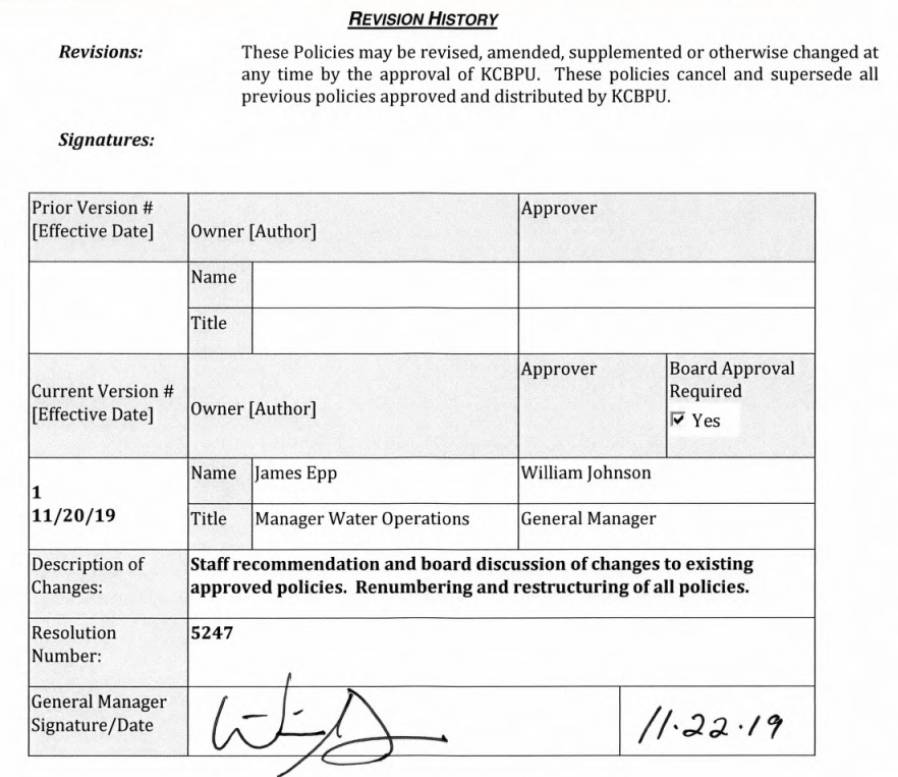
![Revision history table showing prior and current versions, owners, approvers, and description of changes. | Revision History: REVISION HISTORY Prior Version # [Effective Date] Owner [Author] Approver Don Gray Board Approval Required Yes Name Chris Stewart 01-200-014 Rev. 3 10/19/2016 Title Director Civil Engineering General Manager Current Version # [Effective Date] 1 11/20/2019 Description of Changes: Resolution Owner [Author] Approver William Johnson Name James Epp Title Manager Water Operations General Manager Staff recommendation and board discussion of changes to existing approved policies. Renumbering and restructuring of all policies. 5247 Number General Manager Signature/Date WD Wię 11.2219](https://bpu.com/wp-content/uploads/2026/08/rvhistory-1.jpg) |
||

Need Assistance?
Contact Customer Care. We’re here to help.